
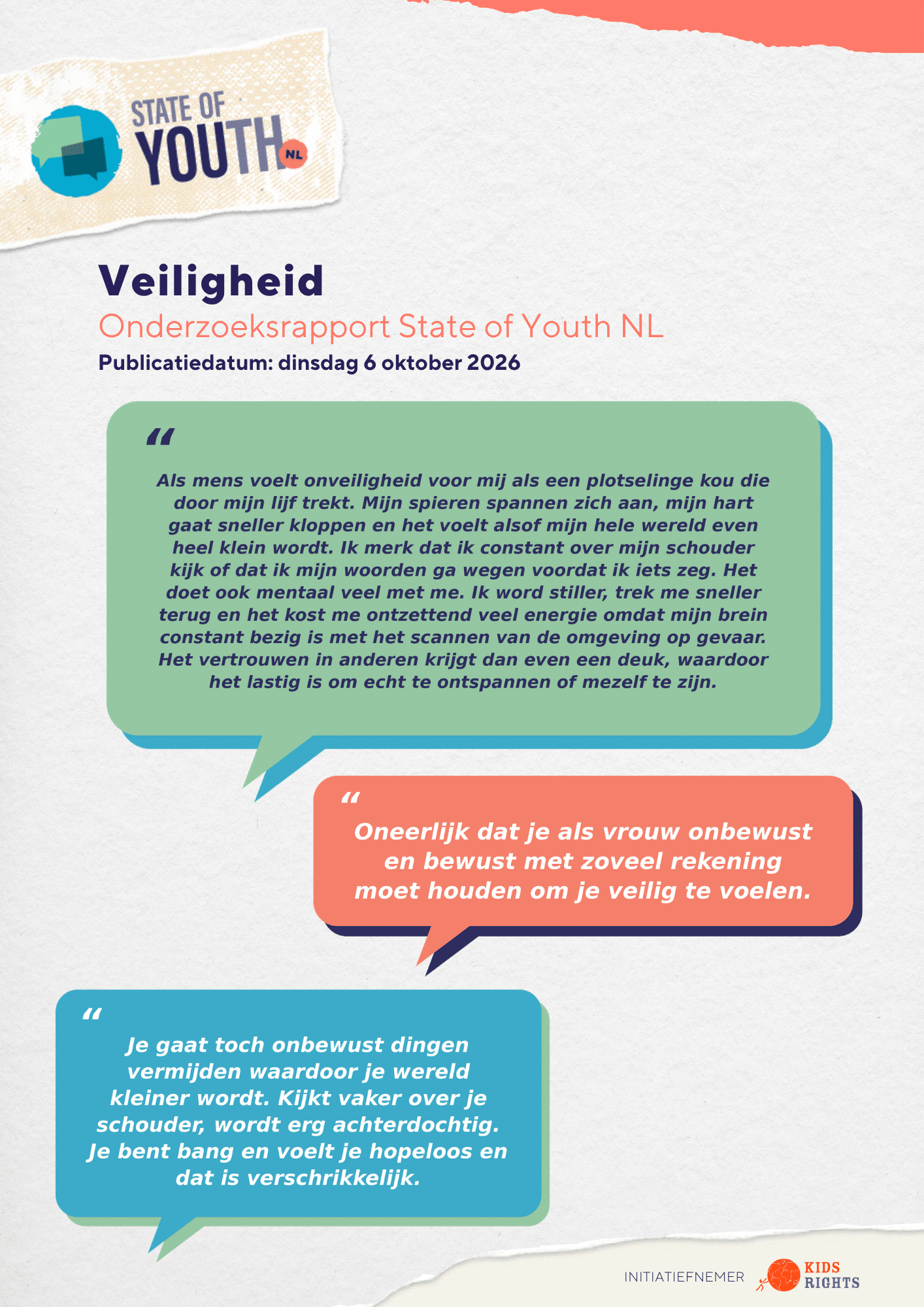
State of Youth NL Research Report: Safety
Research State of Youth NL: Young people do not feel heard on safety. Six in ten young people experience feelings of unsafety, half of girls and young women have experienced sexual harassement or misconduct.
AMSTERDAM, 6 October 2026 – A majority of young people in the Netherlands experience feelings of unsafety in their daily lives. Nearly two-thirds of young people (63%) report feeling unsafe sometimes to often, particularly when walking alone at night (82%) and while using public transport (47%). At the same time, 69% of young people have experienced at least one form of inappropriate or harmful behaviour, ranging from face-to-face insults (47%) to sexual harassment or misconduct (33%) and online bullying (16%). Girls and young women are disproportionately affected: half of them (50%) report having experienced sexual harassment or misconduct. Despite these experiences, many young people feel their concerns are not taken seriously. On average, they rate how well decision-makers listen to them on safety issues at just 5.0 out of 10. These findings come from a representative study among 1,980 young people aged 12 to 29 conducted by State of Youth NL. State of Youth NL is an initiative of KidsRights in collaboration with core partners Maatschappelijke Diensttijd (MDT) and Augeo Foundation.
KidsRights Chair Marc Dullaert –“The fact that so many young people feel unsafe and experience violations of their personal boundaries should be a wake-up call for politicians, municipalities, schools and online platforms. Girls and young women in particular are forced to adapt their lives to a problem that is not of their making. Young people themselves provide clear and practical solutions for improving safety, both offline and online. It is now up to policymakers and organisations not only to listen to young people, but to involve them structurally in decisions that affect their safety.”
This morning, Algemeen Dagblad published an interview with Marc Dullaert on the research. Read the interview here.
Feeling unsafe is a daily reality for many young people
For many young people, feelings of unsafety go beyond isolated incidents and affect their everyday lives. Four in ten young people (41%) actively avoid places where they feel unsafe. Among girls and young women, this rises to 54%.
One participant in the study describes it as follows:
“I carefully think about which route to take, keep looking around me, make sure I have my keys in my hand and often call someone while walking. If I feel unsafe, I keep moving and avoid stopping altogether. Sometimes that feeling of being unsafe even makes me feel sick.”
Young people rate their overall sense of safety at an average of 6.9 out of 10. Girls and young women give a significantly lower score (6.4) than boys and young men (7.5). The findings demonstrate that safety is not an abstract policy issue for young people; it directly influences their freedom of movement, wellbeing and daily behaviour.
Harmful and inappropriate behaviour is widespread, both offline and online
The study reveals that experiences of harmful and inappropriate behaviour are common among young people. Nearly seven in ten (69%) report having experienced at least one form of such behaviour. The most common experiences are face-to-face insults (47%), sexual harassment or misconduct (33%), and physical aggression (28%).
Young people also face significant risks online. Sixteen percent report being bullied online, 16% have received threatening messages and 9% have had images of themselves shared without their consent. Only 30% of young people report experiencing none of these forms of harmful behaviour.
The experiences of girls and young women are particularly concerning. Half (50%) have encountered sexual harassment or misconduct, highlighting that feelings of safety and exposure to harmful behaviour are not shared equally across young people.
Concerns about war and global developments
In addition to experiences in their immediate environment, young people are concerned about developments in the wider world. More than three-quarters (78%) say they worry sometimes to often about wars and international conflicts and their impact on safety in the Netherlands.
One young person shared:
“No war. Why would we do that? There are only ever losers.”
Among those who worry about wars, 35% say these concerns have a moderate to very significant impact on how safe they feel in the Netherlands. This suggests that young people’s sense of safety is shaped not only by personal experiences, but also by broader societal and geopolitical developments.
Young people offer solutions themselves
As in previous State of Youth NL studies, young people do not merely identify problems; they also propose concrete solutions.
To strengthen safety in public spaces, young people most frequently call for:
- Stronger action against bullying and intimidation (56%);
- More attention to mental wellbeing (53%);
- Increased supervision, such as cameras or on-site support staff (51%).
One participant explains:
“Aggressive passengers on public transport should face stricter consequences and not simply be allowed back on a train the next day.”
When it comes to online safety, young people believe the priority should be:
- Faster removal of hateful and harmful content (59%);
- More serious and quicker follow-up of reports (54%);
- Better protection of personal information (50%);
- Fewer fake and anonymous accounts online (41%).
These findings show that young people have clear ideas about how safety can be improved and expect policymakers, platforms and institutions to take their recommendations seriously.
A growing gap between young people’s experiences and their influence
The State of Youth NL safety survey was conducted between 23 April and 12 June 2026 and weighted to reflect the Dutch youth population by age, gender, educational level and province. The findings reinforce a broader trend identified in previous State of Youth NL research: young people feel that their voices are not sufficiently taken into account on issues that directly affect their lives.
On average, young people rate the extent to which they are listened to on safety issues at just 5.0 out of 10. This is comparable to previous State of Youth NL studies, where young people rated government responsiveness at 5.1 on climate issues and 3.8 on children’s rights.
These persistently low scores are at odds with young people’s right to participation as enshrined in the United Nations Convention on the Rights of the Child (UNCRC). The findings show that young people want to contribute to solutions, yet often feel excluded from decisions that affect their safety and wellbeing.
For a safer Netherlands
For young people, safety means more than protection from crime or violence. It also means being free to be themselves, to move through public spaces without fear, to participate online safely and to feel confident about the future.
The findings of this research show that many young people adapt their daily lives because of feelings of unsafety. At the same time, they demonstrate a strong willingness to contribute ideas and solutions. State of Youth NL therefore calls on politicians, municipalities, schools, parents and online platforms to structurally involve young people in the development of policies and measures that affect their safety.
About State of Youth NL, partners and sponsors
State of Youth NL, an initiative of KidsRights, is the megaphone of the new generation: a unique representative online youth panel for Dutch young people with the mission of representing and amplifying the voice of all young people in the Netherlands. State of Youth NL puts issues raised by and with young people on the agenda, shares knowledge about them, and advocates for youth participation. For this research, State of Youth NL worked with Abbi Insights and, for the representative sample, with research agency Motivaction. The research would be unthinkable without the cooperation of young people and the financial support of Vfonds, Janivo Stichting, Dioraphte, Stichting Boschuysen, and core partners MDT and Augeo Foundation.
More news
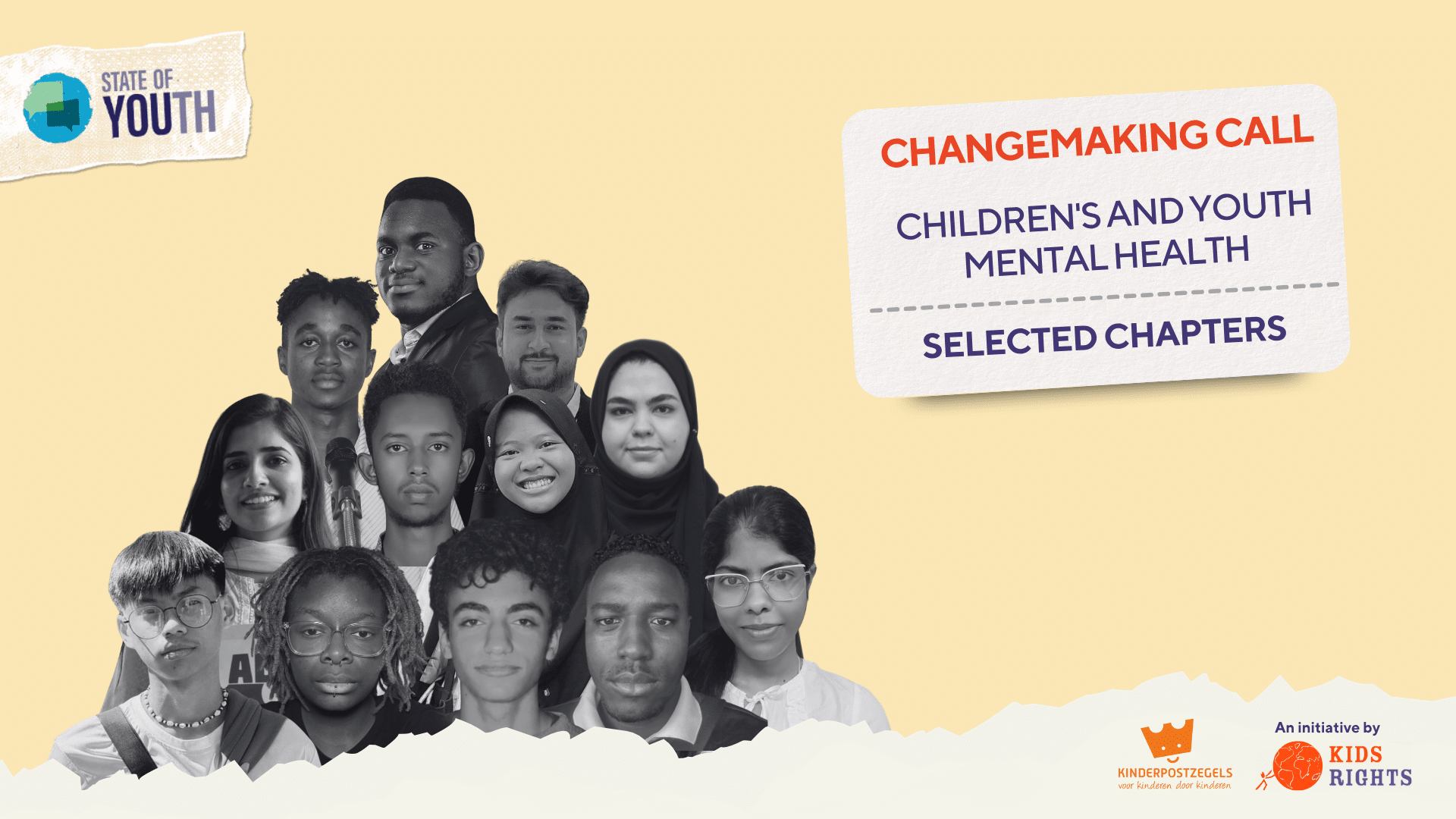
Changemaking Call for children’s and youth mental health.
12 Chapters receive funding through the Changemaking Call for children's and youth mental health!
KidsRights Index 2026: Child-friendly version
The KidsRights Index 2026, now in a version written for children and young people.

State of Youth: Our 2025 Impact Report
Every year, young people around the world prove what's possible when they're given the opportunity and tools lead. Our State of Youth: 2025 Impact Report captures a year defined by exactly that: bold new programs, expanding chapters, and thousands of young changemakers turning ideas into action